3 days
Lot 34:
Description
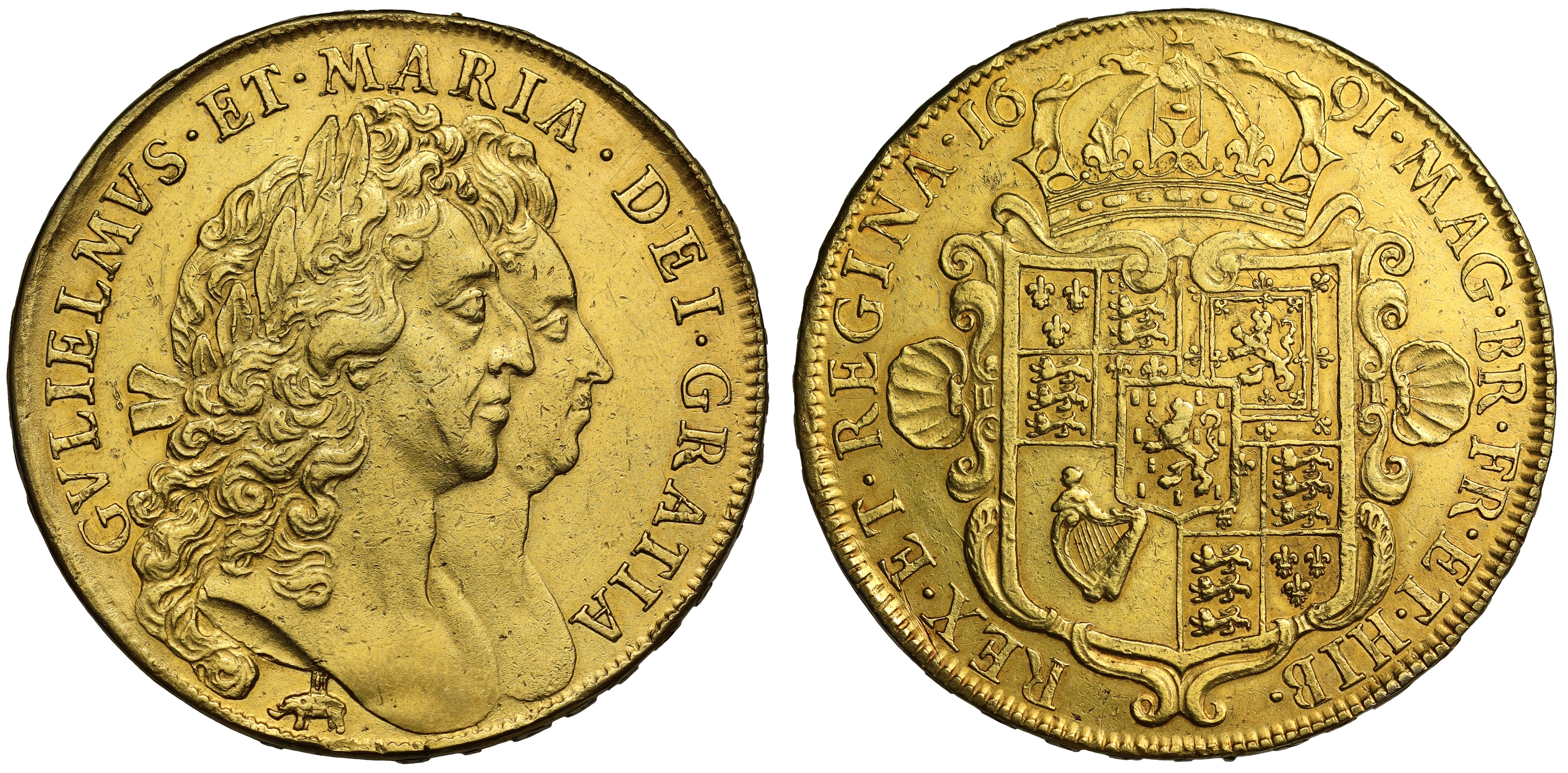
William and Mary (1688-94), gold Five Guineas, 1691, elephant and castle below, conjoined laureate busts right, Latin legend with pellet stops surrounding, GVLIELMVS. ET. MARIA. DEI. GRATIA, toothed border surrounding, rev. crowned quartered shield of arms with scalloped frame, with an escutcheon of the Lion of Nassau, 8 strings to Irish harp, date either side of top crown, abbreviated Latin legend .MAG. BR. FR. ET.HIB REX. ET. REGINA. toothed border surrounding, edge inscribed in raised letters DECVS ET TVTAMEN ANNO REGNI TERTIO, 41.79g (Schneider 461; Bull EGC 345; King -; Holloway 48; M.C.E. 137; S.3423). Cleaned with evidence of edge repair and smoothing from prior mounting, otherwise very fine.
Condition report:
King Survey = 70 examples in commerce over the period 1960-2005, this coin is an addition.The Latin legends translate as on the obverse William and Mary by the Grace of God, and abbreviated on the reverse as King and Queen of Great Britain, France and Ireland.James and Norbert Roettier, the sons of John who was about to retire to Brussels, were the engravers of the coinage and expected to take over his position as Chief(s), however perhaps because they were Roman Catholic, the position of Chief went to George Bowers at Michaelmas 1689, but he later died on 1st March 1690. As the Chief position then went to the Engraver of Seals, Henry Harris, and as he did not have coin die work experience he arranged for the Roettier brothers to work on the coin dies right through till 1697 whereupon a similar arrangement was taken up with John Croker.For 1691 gold output was the second lowest of this joint reign at £54,497 for the calendar year across all the denominations, the highest output being in 1689 at £128,442 worth and the lowest in 1690 at £48,772. This coin is struck from gold supplied by the Royal African Company of England which is defined by the elephant and castle provenance mark below the bust. The company had been so reconstructed by the Duke of York from 1672. The R.A.C. was quite a success trading with Africa and the New World through the 1670s and 1680s, and 1691 was the last good year before troubles started again from 1692, what with the nine years war with France and competition to their African monopoly. For further reading see The Metal in Britain\'s Coins by Graham Birch. We also note an account of the number of guineas coined out of the Royal African Company gold appeared in the Gazetteer and London Daily Advertiser of the 23rd January 1755 which was reproduced in Thomas Snellings publication of 1763. This account tells us that 26,700 Guineas (£29,296worth) were struck presumably out of the £54,497 worth of gold which leaves £25,201 to have been struck into all the other denominations of gold. For 1691 there were all four denominations issued for the Royal African Company as well as Five Guineas, Guineas and Half-Guineas from other sources of gold. Therefore, it would seem the lion\'s share of gold this calendar year came originally from Africa.
Share this lot: